§ Selected work











† Earlier work & arts writing








Writer — Berlin
Irish writer and journalist. Tech, culture, business, health, and harm reduction. Over a decade across staff and freelance roles at the Business Post, Silicon Republic, The Phoenix, and spunout. Commissions: evadiminutive@gmail.com


The Business Post · January 2022
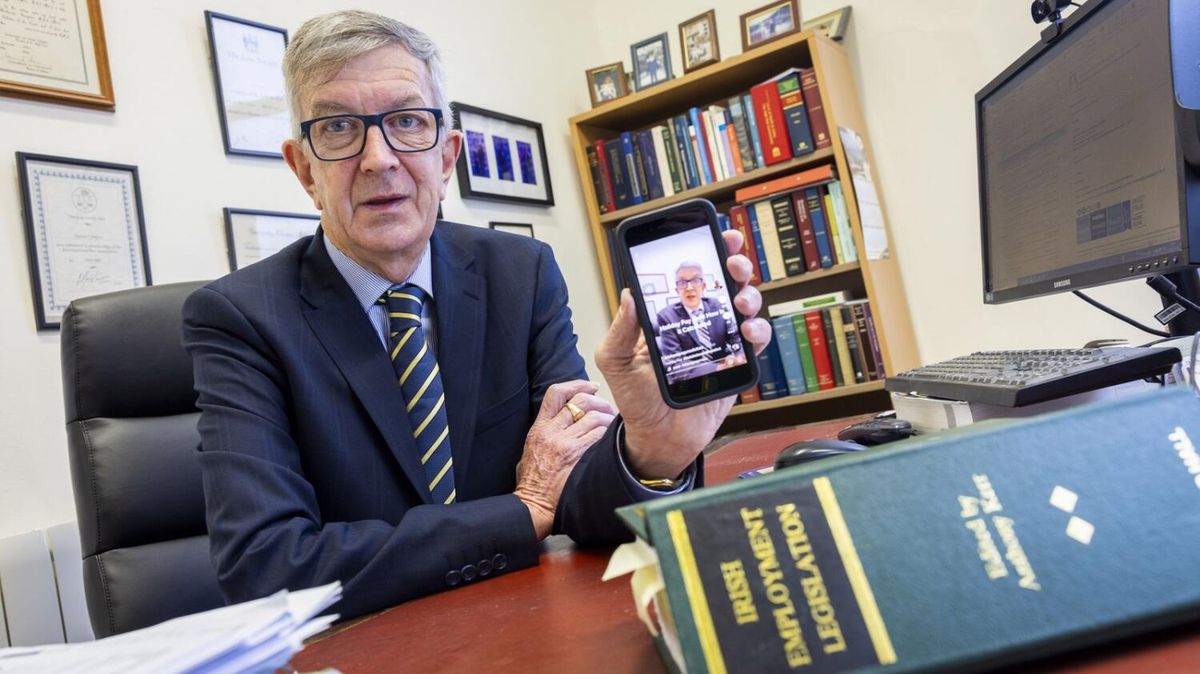
Richard Grogan sits at his desk against a backdrop of framed letters and certificates.
"I'm about to scream with some of the messages I'm getting," he says, wagging two fingers at his phone's camera in the style of a hectoring but ultimately well-meaning older relative. "There is only one annual leave year in Irish law, and that's from April 1 to March 31."
For dramatic effect, he pulls a heavy tome on Irish law – complete with Post-Its sticking out from the edges of the pages – into the shot. "It's in section 2 of the Organisation Working Time Act. I've got a big book – it's written in it."
The Dublin-based solicitor, is one of Ireland's most unlikely TikTok stars. He has amassed 107,000 followers on the platform favoured by Gen-Z'ers since opening an account last month, and become something of a folk hero to young Irish working people.
Grogan, who set up his practice a little over a decade ago, can't really account for this rapid increase in popularity. He has been an active social media user for years, primarily on LinkedIn and, more recently, Instagram.
While giving a seminar to the Law Society of Ireland on how fellow legal professionals can better wield social media last year, someone pointed out that he had yet to migrate to TikTok, eventually prompting him to open his own account.
Grogan doesn't use algorithm-friendly hashtags or the coloured, ambient lighting favoured by most of TikTok's stars, nor does he learn popular dances.
It's just him sitting in his office – or, occasionally at home, as a Christmas tree in the background betrayed over the break – making simple, quick videos explaining elements of Irish employment law, often rounded off with one catchphrase: "That's a law, and that's a fact."
It's this simplicity and lack of agenda that he believes is the likely key to his success.
"I think people just like the fact that I'm slightly different than a lot of other people," Grogan told the Business Post, reflecting on how his follower count hit six digits within his first four days on the platform. "I suppose I came on [TikTok] at a particularly good time, when there were a lot of questions coming up on employment law."
Grogan's videos are typically 30 to 60 seconds long, and tend to stick to more cut-and-dried legislation as opposed to wading into case law. He doesn't use the videos to promote his own services as a solicitor, and said the lack of an obvious promotional agenda is part of what makes the account so popular.
"The motivation behind the account is to give information, it isn't to sell Richard Grogan & Associates," he said. That said, the spate of recent interest has occasionally converted into new clients.
"The fact that people come and talk to me is an added bonus, but the account was not set up for that," Grogan said. "It was set up because this office is part of the Law Society pro bono scheme, and I thought that getting information to people is just as good as running the odd case."
In the run-up to Christmas, many workers, and occasionally employers too, had pressing questions about annual leave entitlements. Throughout the pandemic, questions came up on issues such as whether employers could compel employees who are close contacts to present to work, and if antigen tests or PCR tests were suitable medical certification for time off.
Grogan said that due to the nature of TikTok, it is more difficult to discern the profile of the average follower relative to other platforms. About 45 per cent of his followers on Instagram fall into the 25 to 35 age bracket, and another 27 per cent are aged between 35 and 45, according to his own estimates.
One of the drawbacks of social media, Grogan said, is that those lacking in actual expertise have equal opportunity to put out inaccurate information online.
"There is an awful lot of misinformation on social media these days, and a lot of people putting up information on legal issues who haven't actually got a clue," he said.
Occasionally, followers have even got in touch to say that the advice dispensed in Grogan's videos has helped them resolve an issue with an employer before it became a legal matter.
"Often on Instagram, I'll get a DM directly – yes, I've got all the lingo now – or maybe an email to say a particular video resolved a problem. That's great to hear, because that means that a dispute that was festering in a workplace is no longer there," he said.
Grogan said that the issue of open access to information is one that the Law Society itself has often promoted, and is ultimately beneficial to the profession at large. "If the information is there, it can stop claims arising, but it also means that people who need to bring a claim are are easily able to get the information," he said.
Last month, research released by Cloudflare, the cloud services firm, revealed that TikTok had overtaken Google.com to become the most popular web domain in the world. In the same study last year, it had ranked seventh behind Google, Facebook, Microsoft, Apple, Netflix and Amazon.
According to ByteDance, the Chinese firm which owns TikTok, the site has one billion active users. In a piece published last month, the New York Times revealed details of reports which the firm had shared with advertisers.
In one of those reports, TikTok said Gen Z users, defined as 18 to 24-year-olds, watched an average of more than 233 TikToks a day, and spent 14 per cent more time on the app than millennials or Gen Xers every day.